


Stunted Ambition of a Government Content With Achieving the Bare Minimum in a Climate Crisis: A Breakdown of the 2026 Climate Change Committee’s Emissions Report
This week, Britain’s independent climate watchdog has delivered its verdict on our Government’s progress towards a net zero future, and it is damning!
The 2026 Climate Change Committee’s Emissions Progress Report sets out a clear action plan, yet exposes one of the Government’s biggest missed opportunities: electrification. Electrified technologies could cut emissions faster, strengthen energy security, and ease the financial pressure on households and businesses. Instead, ministers are moving too slowly to match the pace of climate change, even as deadly heatwaves and rising energy bills make inaction increasingly indefensible.
As the Climate Change Committee (CCC) warns:
“The Government is failing to move fast enough to seize the savings electrification can deliver.”
Electrification cannot be lost behind political lines. This is not an ideological development, but one crucial to Britain’s economy and the standard of living of those who live under it.
End The Debate: The Numbers Are Loud Enough
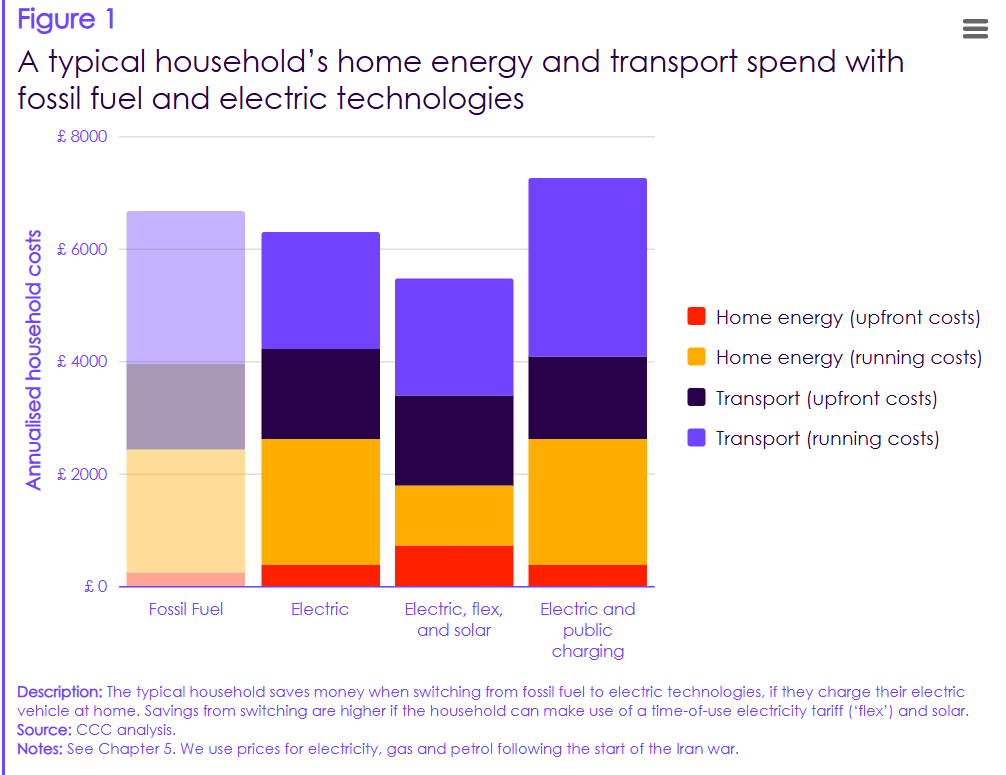
£1,200.
That’s the annual saving for a typical household that switches to an Electric Vehicle (EV), a heat pump, solar panels, and a time-of-use tariff. For rural homes on oil boilers and diesel cars, the saving jumps to £1,880, even without solar.
Whilst the CCC acknowledged that the accessibility of these climate-friendly alternatives continues to be curtailed by their high initial costs, these savings highlight that clean energy is worth its investment!
Electrification not only offers British energy and gas customers a path to reducing their bills long-term, but also provides them with a sense of stability that fossil fuels cannot.
Fossil fuels are the volatile, high-risk option, a fact made brutally clear by the latest price shock triggered by the Iran war. Households with gas boilers and petrol cars saw bills rise four times more than those in electrified homes. For rural oil-heated homes, the multiplier was ten times. Those choosing to dither and delay their investment in clean energy are those who risk making the cost-of-living crisis even worse.
Electrification isn’t just greener. It’s safer, cheaper, and more resilient!
Self-Imposed Stagnation: A Government Limiting Its Impact
The CCC’s report is clear: the Government is dragging its feet when it comes to delivering electrification. And as we have warned for some time, the Government’s plans will fail to meet the UK’s 2030 climate goal submitted under the Paris Agreement.
Yes, there has been progress as electricity supply emissions are down 50% since 1990, a record 8.4 GW of renewables was procured last year, peatland restoration has tripled since 2020 with 21,400 hectares restored in 2025, and steel decarbonisation is advancing through Port Talbot’s electric arc furnace. This is an action to be proud of and we fully support it.
However, these successes mask a deeper problem. This report exposes the fact that the Government’s Carbon Budget and Growth Delivery Plan (CBGDP) is actually less ambitious than the plan it replaced on surface transport and buildings, the very sectors where emissions cuts are most urgently needed.
The gaps are clear:
-
The UK’s 2030 Paris target requires a 68% emissions cut from 1990 levels.
-
The Government’s plan gets us to 65%, a 26 MtCO₂e gap and two missed years.
-
Only 44% of the required emissions reductions have credible delivery plans.
-
The rapid ramp-up in engineered removals to meet the Sixth Carbon Budget lacks detail.
-
A further 17% are not covered at all.
This stagnation comes just weeks after the Confederation of British Industry confirmed that the UK’s net‑zero economy, now worth over £100 billion a year, is generating higher wages and new opportunities across the country. Yet ministers are simultaneously considering weakening the electric vehicle mandate, the Government’s flagship emissions‑reduction policy.

The CCC’s report couldn’t be more clear: a U‑turn on this would increase UK emissions by 13%, raise household fuel costs, and undermine industries already investing in the transition. Meanwhile, electric van sales remain stuck at 9.5%, below mandated target, and 1 in 3 homes lack off‑street parking, limiting access to cheaper home charging.
This year is absolutely crucial for the next phase of the transition, but the Government's plans still lack the ambition required. Its continued reliance on engineered removals, without a credible plan for delivering them at scale, remains deeply alarming.
This is not a marginal shortfall, but rather a structural failure. These challenges are entirely solvable, but only if the Government chooses to act now!
The Opportunity Ahead
The CCC’s report recommends expanding affordable charging ports to increase electric vehicle uptake and accelerating the roll-out of heat pumps through better support for low-income households.
Electric Vehicles
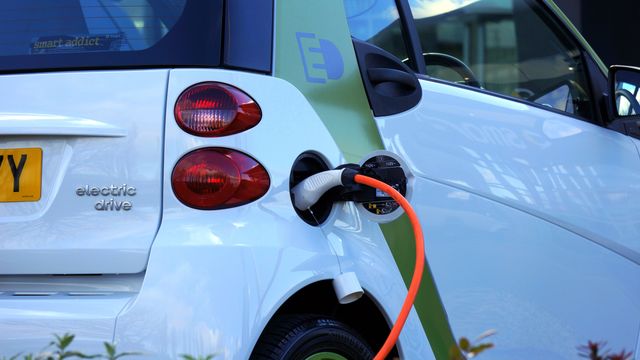
Increasing the accessibility of EVs aligns governmental priorities with market realities as electric adoption is accelerating. 1-in-4 new cars sold in 2025 were electric, creating a landscape where over 2 million EVs are now on UK roads, a 41% increase in a year!
Yet ministers are openly considering weakening the Zero Emission Vehicle (ZEV) mandate that facilitated this transition.
The CCC is unequivocal in its resistance. Limiting this mandate would increase UK emissions by 13%, push households into higher fuel costs, and undermine the industries already investing in the transition.
Heat Pumps
With progress stalling in the building sector, there is a gap in the market for heat pumps to grow.
With fewer than 2% of UK homes having a heat pump, only 52,000 were installed in existing homes in 2025. This data reflects a pattern in which growth has dramatically slowed compared to 2024, greatly undermining the Government’s 2030 target of building 450,000 heat pumps.
Worse still, the Government has closed the scheme, which delivered a third of all heat pump retrofits in recent years, with no clear replacement.
In the words of the CCC, this closure was not only “unambitious” but purposefully limited progress whilst heightening the financial cost of fuel during a cost-of-living crisis.
The Future
The next Prime Minister will inherit more than a set of climate obligations; they will inherit a massive opportunity.

Electrification alone could save 80 million barrels of oil and 1.5 billion therms of gas in 2030, avoiding nearly £8 billion in fossil‑fuel costs. By 2050, it could halve the UK’s wasted energy. The path to meeting our climate targets, strengthening energy security and protecting households is already in front of us. What is missing is the political will to deliver it.
This moment demands urgency. The transition is not simply an environmental necessity; it is the most effective route to economic growth, lower bills, resilient communities and long‑term national security. Every year of delay locks households into higher costs, exposes the UK to volatile global energy markets and deepens the structural weaknesses the CCC has warned about.
The evidence is overwhelming. Electrification is Britain's path to security and prosperity. And for this report to be released in a week when the UK is experiencing the highest June temperatures ever recorded should serve as a wake-up call. The time to act is now!
